

Third edition at PoEM 2025

3 December 2025, University of Geneva
Already the third edition! The past two years, we had some interesting presentations, and the workshop resulted in good collaborative sessions where we had constructive conversations and discussions on the different aspects of the Capability construct. This resulted in a panel report paper that was published in CAIS early 2025. The purpose of FACETE is clear: get the researchers (and practitioners, if possible) around the table to make sure we can strengthen each other's research on Capabilities. Why? Because there is an enormous potential still in practice to use Capabilities as a tool to manage organizations in a better way. But, we also see that in practice, foundations are missing to apply the concept in a proper way. Therefore, if you are conducting research on Capabilities, try to position it in the sub-domains that we defined in the CAIS publication and contribute to the domain, by submitting your original work here.
So, what can you expect? We aim to foster a dialogue-driven workshop, encouraging submissions that showcase ongoing or planned research related to the workshop's themes. However, our call for submissions goes beyond the traditional academic papers, in order to broaden the community and eliminate unnecessary thresholds.
We are opening the call towards practitioners as well. If you have applied a model or approach in practice or have conducted a case study, we encourage you to submit your idea for a presentation, an extended abstract, or a whitepaper. However, please note that this is an academic conference and that all participants, even speakers, need to pay the registration fee.
Call for contributions
Presentations
We invite submissions of presentation ideas, encompassing topics, cases, or studies that are ongoing. Additionally, we welcome presentations about recently published papers in conference proceedings or journals (Published since 1 January 2023). We aim for a maximum of 7 slides, not including the title slide, agenda/structure of the presentation slide, references slide(s) and contact information slide.
Whitepapers
For those working on a broader, less academic level, we invite you to submit a whitepaper of up to 5 pages that explains a concept, argues a point, or proposes a solution related to the workshop's themes.*
Extended Abstracts
If it's too early for a full paper on your study, we welcome extended abstracts of 1-2 pages that summarize your research's goals, methods, and perhaps preliminary findings.*
Position or Short Papers
We encourage submissions of position papers of up to 5 pages that present your viewpoint on a relevant issue or problem, or an innovative idea in the field of capability mapping. Short papers, presenting a study in a condensed manner, are encouraged as well.*
Full Papers
We absolutely do welcome traditional academic papers with a maximum of 15 pages (we aim for a min. of 10 pages, but less is allowed) that delve deeply into a particular area of capability mapping research.*
*all paper formats, including extended abstracts, should be submitted according to the CEUR-WS 1 column template. The exact format can be downloaded from http://ceur-ws.org/Vol-XXX/CEURART.zip.
Workshop format and review of contributions
All contributions will be uploaded on the EasyChair platform. Each submission will be subjected to an evaluation process. Contributions will receive a basic review to ensure their relevance and clarity and receive feedback from the reviewers. Papers aiming to be published in the CEUR-WS proceedings, will be peer reviewed, as required by the CEUR preconditions for publishing (https://ceur-ws.org/HOWTOSUBMIT.html).
Regardless of the submission type, our primary focus is on relevance to the workshop's themes and the clarity of the presentation, rather than the completeness or correctness of the research. Authors of accepted submissions, across all categories, will be invited to deliver a short presentation during the workshop (10 to 15 minutes), the duration of which will depend on the number of accepted submissions and allocated time slots.
The workshop sessions will be focused on discussing these presentations, providing feedback to the presenters, and generating ideas for future research. We will conclude with a plenary discussion, where we aim to collate the insights gathered from the presentations, fostering a shared understanding of enterprise capability and the technique of capability mapping. The goal of this discussion is to build a shared understanding of the concept of enterprise capability and the different aspects of Capability-Based Management, with a special focus on capability mapping, uncovering common ground among varied perspectives. By embracing this inclusive approach, we aim to stimulate a collective conversation that will help shape the future direction of the community's work in defining and understanding capability mapping and its applications in various contexts.
Topics
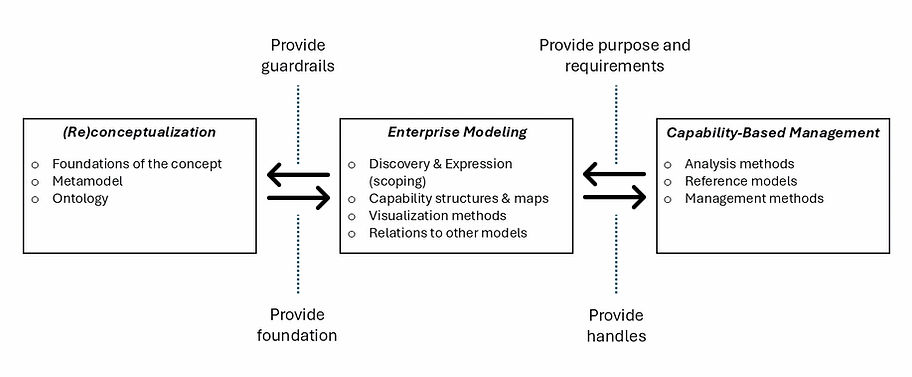
Domain 1: Towards a harmonized foundation for the Capability and Capability Structure/Map concepts.
1. Developing a context-aware definition and model. The cornerstone of this research direction involves crafting a definition and model for capabilities that allow the inclusion of context-aware properties and information as a Capability is not a standalone concept. The model here represents a foundational model, where the core properties of and relationships between capabilities are defined. This entails establishing a framework where the relevance of specific properties of capabilities can be distinctly identified, based on varying contexts and levels of application. The model should be complete enough in coverage yet retain simplicity for practical applicability. Furthermore, the model should facilitate an expanded understanding of the interrelationships among capabilities (e.g. parent-child hierarchies). Investigating formal methods for defining capabilities and their relationships will be crucial to the applicability of the Capability concept in practice.
2. Semantical demarcation of the capability concept. The concept of Capability (understood as Enterprise Capability) is still perceived as a vague and convoluted term. This holds both in academic and industrial settings, even though capabilities have received a lot of research focus during the last two decades. A plausible explanation is that industrial and academic researchers bear increased levels of familiarity with other terms in Information Systems that are commonly used and encountered, for example, service, process, task, activity, etc. For this reason, capabilities need to be semantically distinct. Efforts have already been put toward this task (Tell, 2014)[1], yet, our experience in the field has shown that more effort is required in this direction. This indicates the need for a clear identification of the characteristics that make Capability a distinct concept with clear boundaries.
3. Formalizing the operational dimensions of capabilities. This area of research focuses on clearly defining the operational dimension of capabilities. When designing a capability to achieve a specific outcome, the operational dimension must also be designed. This involves configuring resources and behaviors that enable the capability to be deployed effectively in a given context. Critical resources and behaviors include people (considering various human aspects), systems and technology, information, and processes. Without these elements, the capability cannot be implemented or delivered. Moreover, when the purpose of the capability or the context in which it operates changes, the organization must reconfigure these resources and behaviors to adapt to the new conditions (Koutsopoulos et al., 2024)[2].
The operational configuration of an entire organization can be viewed as the aggregate of all operational configurations of its capabilities and the relationships among them. This provides a broad perspective of the organization's overall operational setup. The goal is to establish a structured framework that explains how capabilities and these operational dimensions are related to each other, thereby offering a holistic view of organizational functioning. By formalizing these relationships, organizations can achieve a deeper integration of capabilities into their strategic and operational fabric, ensuring that capabilities are effectively leveraged to drive organizational success.
Domain 2: Towards a better-defined and grounded Capability-centered modeling techniques
1. Goal-oriented strategic capabilities modeling language. Investigate the development of a domain-specific modeling language (DSL) for goal-oriented modeling of strategic capabilities. Strategic means that capabilities align with organizational objectives, facilitating a nuanced approach to depicting and understanding capabilities within a strategic framework. This DSL should offer clarity and flexibility, allowing organizations to model their capabilities in alignment with strategic goals.
2. Bridging capability models and strategy models: investigating and formalizing relationships. This suggested key research area endeavors to explore and formalize the connections between capabilities and established strategy models and their accompanying methods, such as the Business Model Canvas, the Balanced Scorecard, and Strategy Maps. The objective is to uncover how capabilities interact with, complement, and enhance these models, thereby offering a multidimensional approach to strategic planning and strategy implementation in the context of Enterprise Architecture.
3. Pre-analysis capability identification. One challenging aspect of operationalizing the concept of capability is the discovery and identification of enterprise capabilities. This refers not only to identifying individual capabilities for analysis in the light of CBM, but also to define the entire set of capabilities that constitute an organization's capability structure. One possible way of identifying enterprise capabilities is to utilize existing enterprise models or develop new ones for this purpose, as suggested in (Bider & Perjons, 2023)[3]. However, after the initial discovery, the subsequent challenge lies in demarcating the boundaries of each capability, especially when it concerns capabilities that may share tangible, intangible, and human resources. Future research should aim to refine this procedure by, for instance, developing robust frameworks to assist in the discovery and identification of capabilities and their boundaries. Although earlier efforts like those (Sandkuhl & Stirna, 2018)[4] have advanced the state of this research area, more detailed approaches are still required. Such contributions will provide significant support, setting up a structured pre-analysis phase that will improve the outcomes of capability modeling and mapping and CBM as a whole.
4. Capability size and scaling. A challenging aspect that often emerges during capability-based management and analysis is determining the appropriate and acceptable size for capabilities. By capability size, we refer to the proper level of abstraction applied during capability identification. Our experience indicates that identifying a capability at its proper size is not always straightforward. What is often perceived as a capability may lead to sub-optimal analysis if it is either "too small" or "too large.". Future research should aim to develop metrics for determining the size of capabilities, which may result in a need to introduce the concept of micro-capabilities, in a way similar to micro-processes or micro-services, which are already established. This refinement is also relevant to the aspect of ownership which is discussed as part of the following research topic.
5. Capability ownership in the context of ecosystems. The ownership of an enterprise capability is an essential aspect of CBM, especially when it comes to contemporary organizations that are often part of multiple and extensive organizational ecosystems. Even in relatively simple cases where a capability spans across two organizations and shares their resources, hitherto, there is no clear and distinct way to identify the boundaries and establish capability ownership. This task becomes significantly more challenging and complex when dealing with intricate ecosystems. Future research in CBM needs to address these key questions: Are an organization’s capabilities also considered capabilities of the ecosystem? Can ecosystem capabilities be effectively identified as singular capabilities, or do they require decomposition to optimize analysis?
6. Formalizing capability map creation. There is a clear call for designing a structured methodology for creating capability maps as a specific visual representation, focusing on enhancing documentation and maintenance practices. This method should simplify the complex process of mapping capabilities, making it more accessible and sustainable for organizations to keep their capability maps up-to-date and relevant.
Domain 3: Towards a better-defined and grounded Capability-Based Management practice.
1. Contextual relevance of capability models. There is also a call for exploring which types of capability models, including but not limited to capability maps, are most effective in varying scenarios, identifying the contextual factors that determine their relevance. This research aims to provide guidance on selecting the appropriate models based on specific organizational needs or challenges.
2. Formalizing CBM applications. This topic involves investigating and presenting relevant use cases of CBM, aiming to formalize the methods underlying these applications. This exploration should uncover the practical implications and benefits of capability-based approaches, providing a structured framework for analysis and presentation.
3. Usability and adoption of capability models. This involves examining how capability models, including capability maps, and their applications are perceived in practical settings. This research seeks to identify barriers to usability and adoption, offering insights into how these models can be refined to enhance their practical utility and organizational integration.
4. Industry-specific capability maps. Initiating the creation of reference capability maps tailored to specific industries or domains. This effort aims to provide standardized frameworks that can serve as benchmarks or starting points for organizations within those sectors, facilitating a more straightforward application of CBM practices.
5. Identification of performance metrics associated to capabilities. The identification and implementation of specific performance indicators, indices, or metrics tied to specific capabilities would drive not only the perception of realization during the manifestation process of each individual capability; rather, the establishment and monitoring of such metrics can serve as a benchmark for comparing capability performance with other organizations in the same industry, thereby improving overall efficiency and effectiveness.
Each of these topics is designed to contribute to the evolution of CBM practices, ensuring it is both theoretically robust and practically applicable.
[1] Van Riel, J., Poels, G., Koutsopoulos, G., Calhau, R. F., Bider, I., Perjons, E., Wautelet, Y., & Tsilionis, K. (2025). Advancing the Domain of Strategy Planning and Implementation through Enterprise Architecture: A Research Agenda for Capability-Based Management. Communications of the Association for Information Systems, 56, 155-166. https://doi.org/10.17705/1CAIS.05606)
[2] Tell, A. W. (2014). What capability is not. In Perspectives in Business Informatics Research: 13th International Conference, BIR 2014, Lund, Sweden, September 22-24, 2014. Proceedings 13, (pp. 128–142).
[3] Koutsopoulos, G., Andersson, A., Stirna, J., & Henkel , M. (2024). Application and evaluation of interlinked approaches for modeling changing capabilities. Software and Systems Modeling, 23, 895–924.
[4] Bider, I., & Perjons, E. (2023). Can an enterprise model help in mapping capabilities? In Proc. 1st FACETE Workshop, Vienna, Austria, November 29, 2023. https://ceur-ws.org/Vol-3645/facete3.pdf
[5] Sandkuhl, K., & Stirna, J. (2018). Capability management in digital enterprises. Springer.
Intended outcomes
The intended outcome of the workshop will be two-fold:
Proceedings
Accepted short/position and full papers will be published in the online CEUR-WS proceedings (which is not mandatory, but rather an option offered to those who wish to formalize their contribution). This will provide a comprehensive documentation of the rigorous academic discourse and innovative ideas explored during the workshop. These proceedings will serve as a valuable resource for scholars and practitioners interested in capability mapping, Enterprise Architecture, transformations, and ESG initiatives.
Workshop Report
After the edition of 2023, we co-create a workshop report post-event with the participants in the form of a paper, which is currently under submission for publicatiojn. This collaborative document captures the nuanced discussions, key insights, and shared understanding developed during the workshop. Our objective was to collectively articulate a vision for Capability Mapping research, incorporating perspectives from both academia and industry, with the intent to serve as a future research agenda.
For the second and following editions, we aim to publish an update in the form of a report/paper on this website, in a less formal way, via an open access platform. The aim remains to keep the community informed.
Important Dates
-
Workshop paper/contribution submission deadline: 12 October 2025 (extended)
-
Workshop author notification: 4 November 2025 (extended)
-
Workshop author registration: 10 November 2025 (extended)
-
Workshop day: 3 December 2025
-
Workshop preface and camera-ready papers: 18 November 2025
Program Committee members
Confirmed PC members for the third edition:
-
Martin Henkel, Stockholm University, Sweden
-
Jürgen Jung, Frankfurt University of Applied Sciences, Germany
-
Ben Roelens, Open University, The Netherlands
-
Frank Grave, Open University, The Netherlands
-
Evangelia Kavakli, University of the Aegean
-
Kurt Sandkuhl, Universität Rostock
Other committee members are being invited and will be announced soon.
Agenda
Time | Topic | Presenter |
|---|---|---|
08:30 | Registration | N/A |
09:00 | Opening statement | Jonas Van Riel |
09:05 | Paper session | TBA |
09:35 | Paper session | TBA |
10:05 | Paper session | TBA |
10:30 | Coffee Break | N/A |
11:00 | Collaborative session part 1 | TBA |
12:30 | Lunch | N/A |
13:30 | Collaborative session part 1 | TBA |
14:45 | Open feedback round: connect the community.
Closing statement | Jonas Van Riel |